SEO results with real data – Google Search Console figures from 3 projects
SEO is easy to discuss in general terms, so this article instead shares real Google Search Console data. We will look at three websites: a B2B Shopify store, a travel website and my own Blasterr Design website.
The two client projects have been deliberately anonymised: domains and client names are hidden, but the figures are reproduced unchanged from their Search Console reports. The screenshots and comparisons use data through August 28, 2026.
In brief: in the three-month view, one anonymised Shopify store recorded nearly 10,000 impressions and 347 clicks with an average position of 7.3; the travel project generated 5,870 impressions and 74 clicks; and Blasterr Design recorded roughly 72% of its 12-month total of 6,100 impressions in the final three months.
What does Google Search Console actually show?
In an SEO report, it is worth looking at more than one metric. An impression indicates that a page appeared among Google's search results, a click shows an actual visit from organic search, CTR measures the ratio between the two, and average position provides an aggregated view of rankings.
These metrics need to be read together. For example, when a website starts appearing for many new searches, impressions can rise rapidly even if some of the new keywords initially rank around the second or third results page. CTR may fall during this period even while the site's organic visibility is expanding.
. That is why technical foundations, page structure and search intent matter just as much as the text itself. I explain complete website architecture on the website development service pageand the development process in the step-by-step website development guide.
Figures from the three projects together
The projects have different business models, content volumes and search competition, so it would be misleading to rank them against one another. Instead, the figures illustrate what organic search signals can look like for different types of website as their technical and content foundations begin to take effect.
| Project | Period | Clicks | Impressions | CTR | Average position |
|---|---|---|---|---|---|
| B2B Shopify store | 3-month view | 347 | 10 E | 3,5% | 7,3 |
| Travel website | 3-month view | 74 | 5,87 E | 1,3% | 19,9 |
| Blasterr Design | 12-month view | 37 | 6,1 E | 0,6% | 21,1 |
| Blasterr Design | final 3 months | 18 | 4,42 E | 0,4% | 19,2 |
1. B2B Shopify store: 10,000 impressions and 347 organic clicks
The first anonymised project is a B2B-focused Shopify store selling premium products. Its three-month Search Console report shows 347 clicks, nearly 10,000 impressions, a 3.5% CTR and an average position of 7.3.
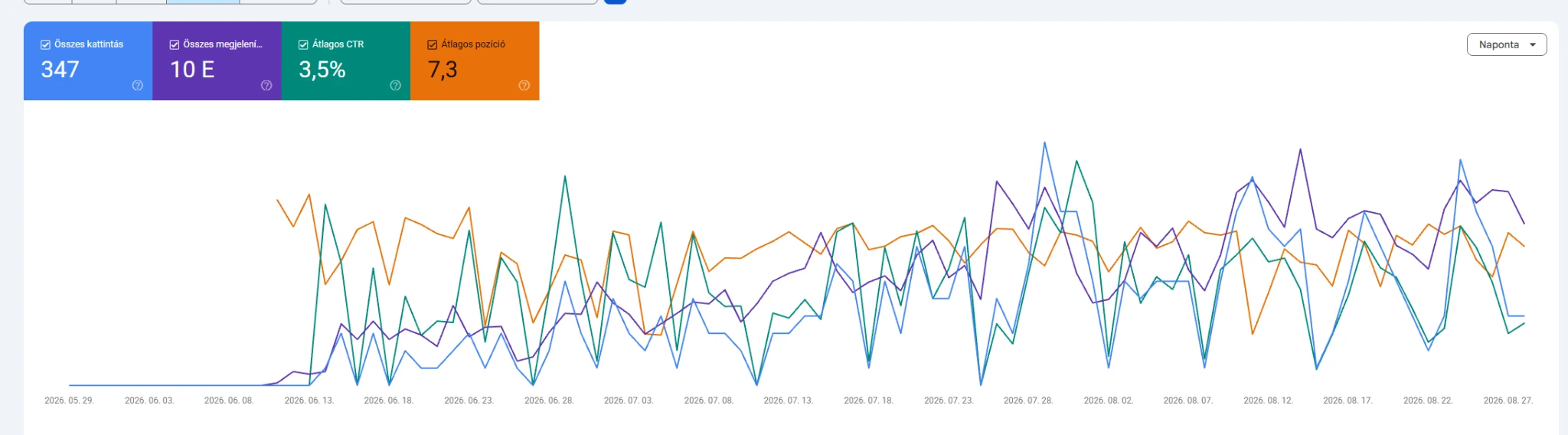
A An overall average position of 7.3 is a notable signal because it falls within the first page of search results. An online store also needs more than a single URL to perform: category, product and informational pages work together to build its search presence.
Alongside visual improvements, this project therefore focused on product structure, unique metadata, canonical URLs, internal linking, mobile usability and making the store technically understandable to Google. If you're considering a store, the Shopify store development page also explains how I build the shopping journey and technical foundations.
Key takeaway: in store SEO, the aim is not for the homepage alone to rank. With a good structure, multiple product and category pages can become independent entry points from organic search.
2. Travel website: 5,870 impressions and broader search coverage
The second anonymised project is a content-heavy travel website with a constantly changing range of offers, destinations and detailed pages. The Search Console report examined shows 74 clicks, 5,870 impressions, a 1.3% CTR and an average position of 19.9.
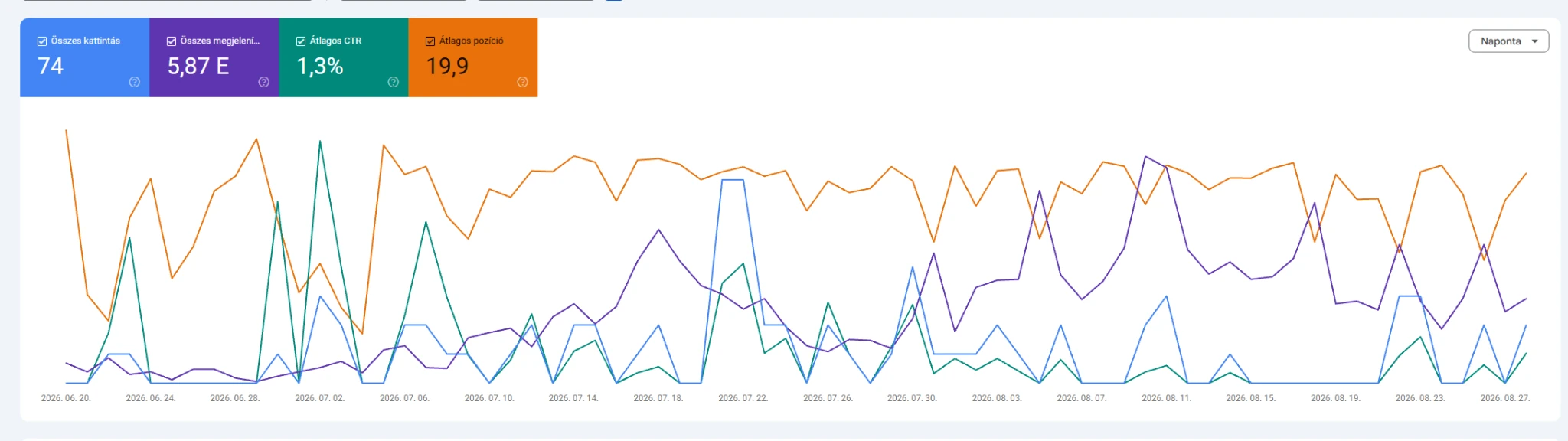
At first glance, an average position of 19.9 looks much weaker than the previous store's 7.3, but the average can be misleading. A content-rich site may appear for hundreds of different, sometimes new search combinations. Some initially rank further down while other pages already bring in clicks.
For this kind of platform, much of SEO is technical: sitemaps, canonical URLs, control of indexable addresses, consistent page hierarchy, responsive images and stable internal links. If an older website's structure no longer supports this, the article on website redesign explains when a larger overhaul may make sense.
Key takeaway: growing impressions can be an important early signal on their own. Google may initially test pages across a broader range of queries before more stable positions and click-through rates emerge.
3. Blasterr Design: 72% of 12-month visibility in the final three months
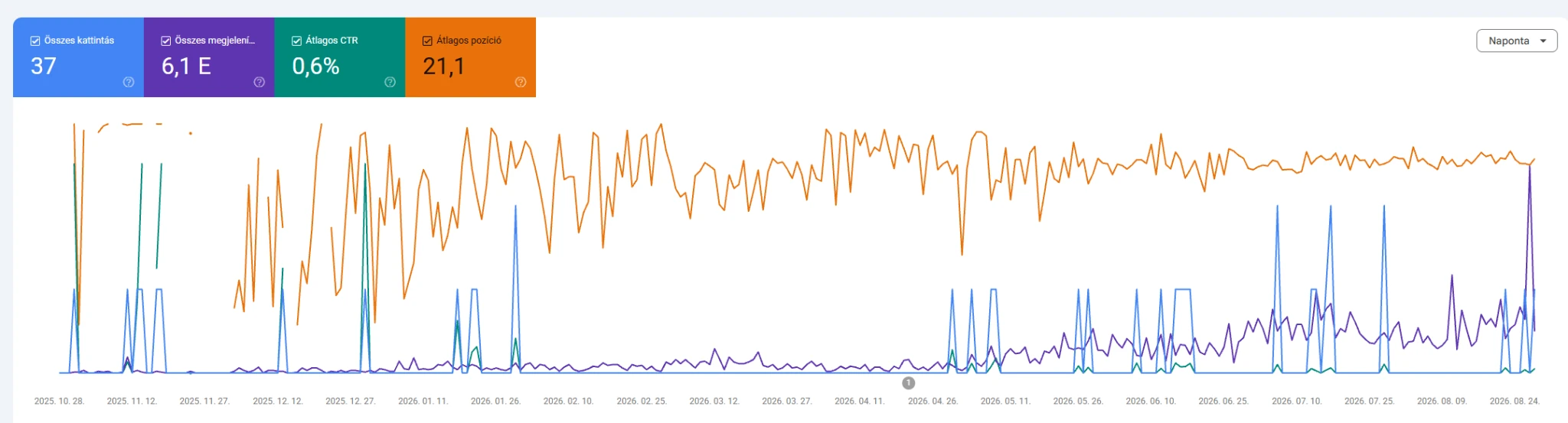
The third example is my own website, so the data does not need to be anonymised. The 12-month Search Console report shows 37 clicks, 6,100 impressions, a 0.6% CTR and an average position of 21.1.
The most interesting part, however, is the recent period. The final three months alone generated 4,420 impressions, accounting for roughly 72% of the full 12-month visibility. In that same three-month view, the average position was 19,2, compared with the 12-month average of 21.1.
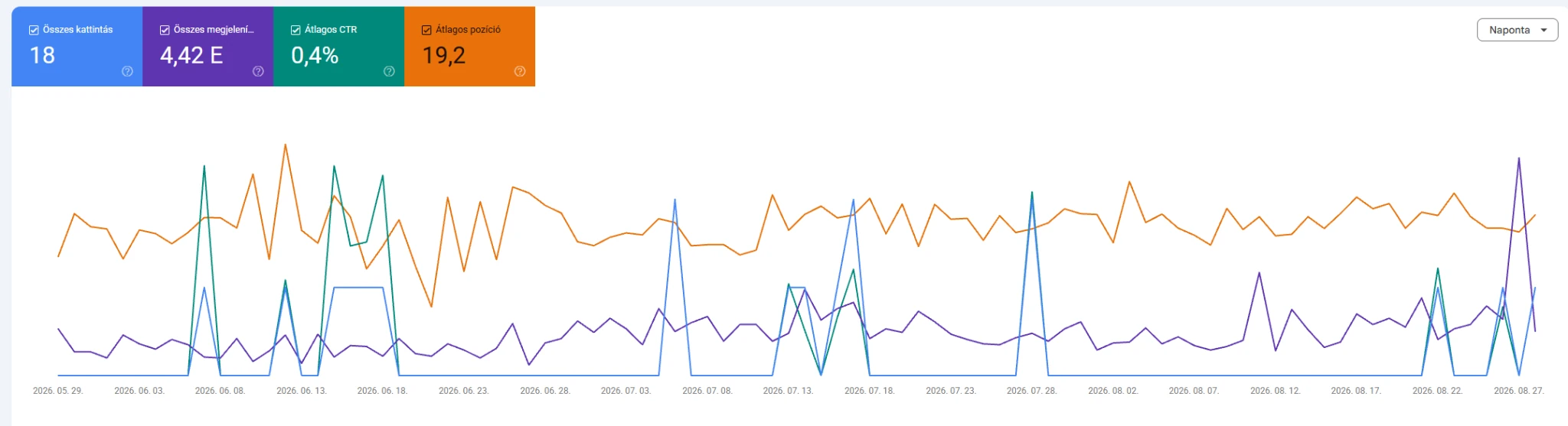
Weekly impressions also accelerated during August: the first seven days recorded 272, the second week recorded 374, and the third 406, and the week of August 22–28 reached 592 impressions. Between the first and fourth weeks, this represented approximately 118% growth.
This matters more than one unusually strong day because the baseline rose across several consecutive periods. Meanwhile, several separate blog topics became independent organic entry points, including the brand identity design guide and the article on colour psychology.
The recent three-month CTR is below the 12-month average, but I do not interpret it in isolation. New search terms appeared in detailed query reports, suggesting Google was testing the site across an increasingly broad range of topics. During such a phase, it is not useful to rewrite titles, H1s or content blocks that are already progressing every few days.
What can we learn from the three projects?
1. SEO results are not just clicks
Without clicks there are no organic visitors, of course, but earlier in the process, rising impressions show how many different searches Google is starting to associate with a website. For a new or recently restructured site, this is often the first substantial change.
2. Average position does not tell the whole story
One average combines keywords in the top three, a service page in twelfth place and a newly appearing long-tail query in sixtieth place. That is why it is worth checking individual pages and queries to understand what drives the overall figure up or down.
3. Technical SEO and content work together
Even good writing can lose its potential if Google indexes incorrect URLs, canonical signals are inconsistent, the sitemap is inaccurate or important pages have few internal links. Equally, flawless technical implementation cannot replace content that genuinely answers search intent.
4. When results start coming in, another change is not always the answer
After SEO improvements, Google needs time to recrawl pages and test them for different searches. If impressions are growing, new queries are appearing and key pages are improving in position, it can often be better to allow more data to accumulate than to keep changing the same page repeatedly.
What does SEO development mean in my work?
I do not treat search engine optimisation as a standalone keyword list. From the website planning stage, it matters that both visitors and search engines can understand the structure. Depending on the project, I review:
- page structure, URLs and internal linking;
- unique page titles, meta descriptions and H1 hierarchy;
- canonical URLs, indexing, robots directives and sitemaps;
- mobile usability and loading performance;
- image sizes, WebP use and descriptive alt text;
- structured data and technical issues;
- service, product and blog content aligned with search intent;
- monitoring Search Console data after launch.
For a new project, this can be built into the foundations of website development or the or Shopify store development. For an existing website, it makes sense to start by identifying what already works, what is limiting growth and which changes have real priority.
You can find more completed projects in my portfolio. If you want to review your own site's organic performance, you can contact page contact me about your project.
Frequently asked questions
How long does it take to see SEO results?
There is no fixed timeframe that applies to every website. Impressions and the number of indexed, ranking pages often change first; as Google collects more data, positions and clicks may then become more stable. The site's history, competition, technical condition and content all affect the pace.
What does an impression mean in Google Search Console?
An impression occurs when one of your website's results appears in a user's Google search results. Sustained growth in impressions may indicate that Google is connecting the site with relevant topics across an increasing number of searches.
Can SEO performance improve while CTR decreases?
Yes. When many new queries appear, some initially rank further down. Impressions may therefore rise faster than clicks. CTR can temporarily decrease while search coverage and several important positions improve.
Why are the client projects anonymised?
To show real performance data without unnecessarily disclosing clients' domains or business information. The Search Console figures for the two client projects are unchanged, while Blasterr Design's own data can be shared publicly.
Want to find out where your site is missing organic opportunities?
I can review the technical foundations, site structure, mobile usability, metadata and Search Console signals, then prioritise what to change and what to leave alone.
Request an SEO and website auditWant a quick website check?
The mini audit helps you review important content, visual and technical points before starting a larger development or redesign project.