How much does a Shopify store cost? Setup and ongoing fees
The cost of launching a Shopify store is not one fixed number. Building the storefront is a different expense from running it. Your product range, existing branding, chosen theme and required integrations affect the initial project. After launch, your Shopify plan, apps, payment processing and ongoing support determine your running costs.
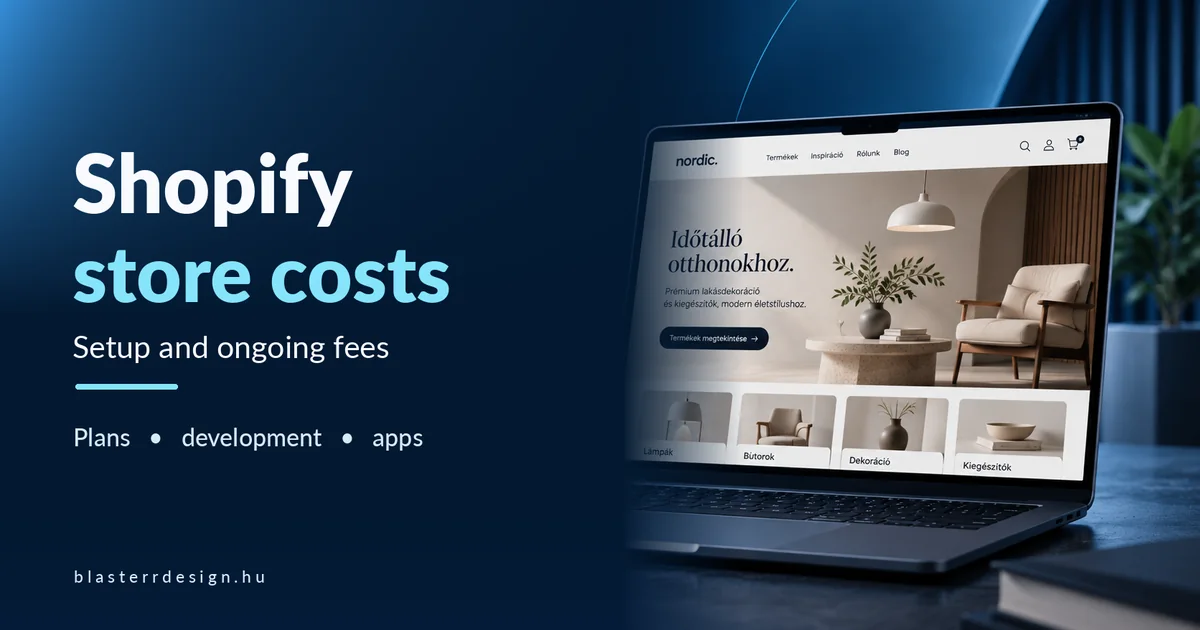
Strategy, design, build and integrations.
Shopify subscription, domain and optional apps.
Payment processing and fulfilment-related expenses.
The short answer: plan separately for your initial design and development, Shopify subscription, and ongoing operating costs. There is no one-size-fits-all development package: I prepare a tailored proposal based on your products, design requirements and the features you actually need. You do not need a fully detailed brief to get started; a short description of your idea is enough for an initial conversation.
What makes up the cost of a Shopify store?
A useful budget has three parts: the one-off work required to launch, extra purchases you may make at setup, and the recurring or order-based expenses of operating the store.
| Cost item | When it usually applies | What affects it |
|---|---|---|
| Store design and development | At launch or during a major redesign | Structure, product data, design and integrations |
| Shopify theme | If you choose a paid theme | Free or premium theme and its licence |
| Shopify subscription | Recurring | Plan, billing term and region |
| Domain name | Usually annually | Extension and domain registrar |
| Apps and integrations | Optional, often monthly | Required functions and app tiers |
| Payment processing | Per order | Payment method, provider and plan |
| Maintenance and improvements | As needed | New features, updates and ongoing support |
1. One-off store design and development
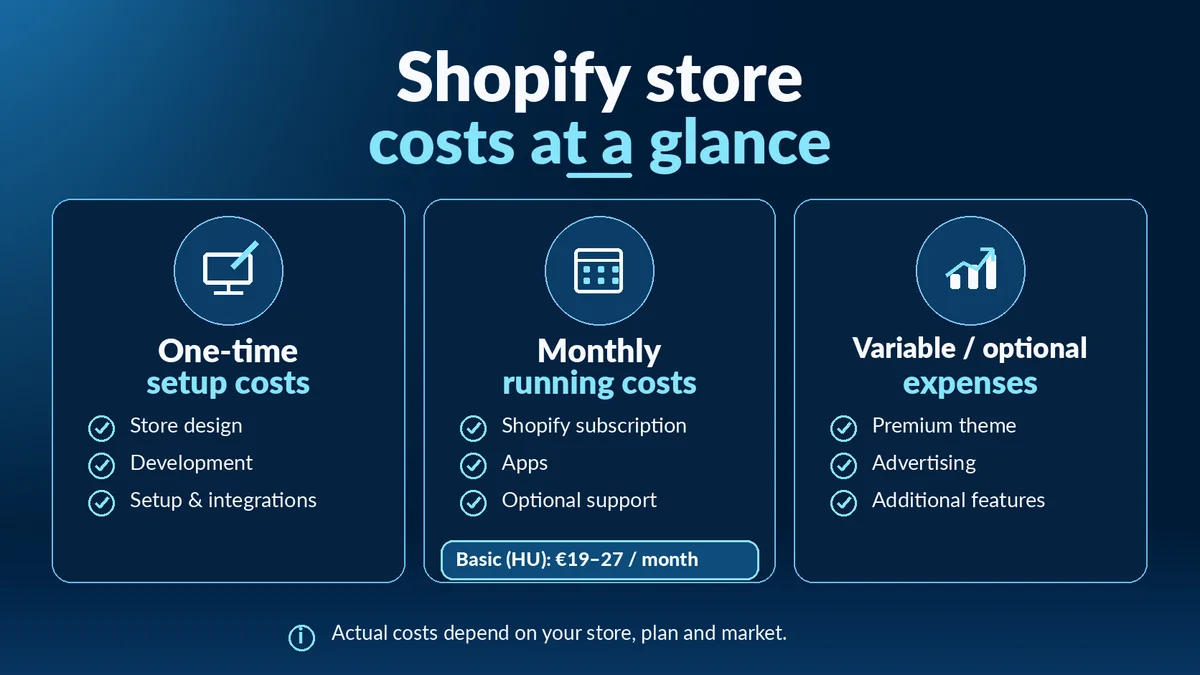
A development fee covers more than installing a theme. A store needs a clear homepage, product and collection structure, mobile navigation and a shopping experience appropriate for its products. Depending on the project, the scope may also include brand styling, complex variants, payment and delivery setup, integrations and pre-launch testing.
No two Shopify projects require the same scope. A focused store with a handful of products and a larger catalogue with custom integrations involve different kinds of work. My website pricing guide explains the considerations behind other website types; for Shopify stores, I prepare a project-specific proposal after learning what you need. That way, your store does not have to fit a predetermined package or a converted local starting price.
2. Shopify monthly subscription fees
Shopify is a subscription platform. Its monthly fee pays for the platform and core store infrastructure; it is not the same as hiring a designer or developer.
As a Hungary-specific example checked on 1 October 2026, Shopify's official local price page listed Basic at €19 per month with annual billing, or €27 per month with monthly billing. Prices, promotions, taxation and available plans may vary by location and can change. Before making a decision, check Shopify's current pricing for your market or its Hungarian pricing page.
The Shopify plan normally includes core hosting and store infrastructure. You generally do not need to purchase an additional website hosting package, but that does not mean your domain, premium apps or transaction costs are automatically covered.
3. Free or premium Shopify theme?
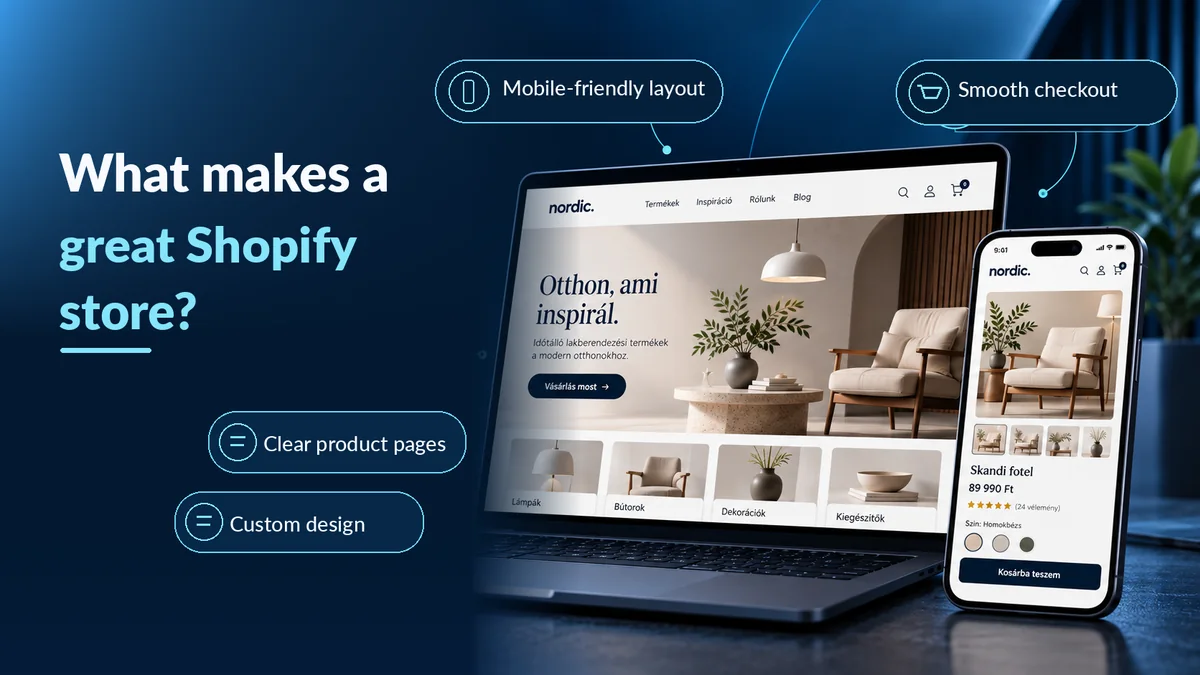
Shopify has both free and paid themes. A free theme can be an excellent fit if it already supports the navigation, product information and visual structure you need. A premium theme is not automatically the better investment.
Before selecting a theme, review its product cards, collection layouts, mobile interactions, variant selectors and how much customisation your brand requires. A cheaper theme can become more expensive overall if important functionality has to be built separately.
The key is to choose the theme for the product and customer journey, rather than making the entire store fit whichever demo looks most attractive.
4. Apps and local integrations
Some functionality is included in Shopify or your theme, while other requirements may need an additional app. Common examples include parcel-point selection, invoicing integrations, specialised product options and selected marketing automations.
Every extra app may introduce a subscription, configuration work or a maintenance dependency. I start by identifying the business requirement and checking what the platform can already do before recommending another app.
For a store targeting Hungary, shipping providers, parcel collection, invoicing, local payment methods and clear delivery communication should be discussed early. For a store operating in other markets, evaluate the equivalent local requirements rather than copying a setup from another country.
5. Single-product store or larger catalogue?
Product count matters, but it does not tell the whole story. A single-product store can have fewer collections while requiring more distinctive storytelling, landing-page design and variant selection. Even one product can involve several sizes, finishes or different purchase options.
A larger catalogue adds complexity through collection structure, navigation, product data, filters and comparison. My Office Art & Design Shopify case study shows how product presentation and information hierarchy matter for a more complex store.
A realistic project budget starts with your actual product range, not an arbitrary number of pages or products.
6. Additional expenses people overlook
Your store also needs content and operational planning. Product photography, writing, branding assets, marketing, packaging, fulfilment and professional preparation of relevant legal and accounting documents can all be separate items.
Payment processing costs should not be confused with Shopify's subscription price. Actual fees depend on your chosen provider, local market, payment method and plan. Confirm the current terms with the payment provider rather than relying on a generic percentage.
If you want to sell internationally, account for languages, currencies, delivery regions and the work of maintaining consistent content across markets from the beginning.
Example: a practical starting budget
For a smaller store targeting the Hungarian market, the budget might include the items below. This is a planning example, not a quotation, and prices will differ elsewhere.
| Item | Planning assumption |
|---|---|
| Initial store design and build | Tailored proposal based on design, catalogue and required functionality |
| Shopify Basic | €19/month if billed annually or €27/month if billed monthly on the Hungarian price page, checked 1 October 2026 |
| Store theme | Free, or a separate premium theme purchase |
| Domain and apps | Depending on your actual requirements |
| Payment processing | Based on orders, payment method and market |
| Creative assets and marketing | Set a separate budget appropriate to your launch |
Keep initial costs, fixed recurring costs and order-dependent expenses in separate categories. It makes pricing decisions and future growth considerably easier to plan.
7. How to request a useful Shopify proposal
A good proposal specifies the page templates and functionality being built, who is responsible for product uploads, who provides photography and copy, which integrations are included and how testing and handover will work.
I start by reviewing the product range, target audience, desired purchasing journey and available brand materials. That makes it easier to distinguish must-haves from features that can be added later. The Shopify store design and development service describes the kinds of projects I take on.
Frequently asked questions
Is a free Shopify theme enough for a new store?
Often, yes. If it supports the features you need and you can adapt its visual presentation to your brand, a paid theme is not necessarily essential at launch.
Does the development fee include the Shopify subscription?
Not by default. The one-off project fee and Shopify's own subscription are separate expenses. A proposal should make any exceptions explicit.
Is a single-product Shopify store always cheaper?
Not necessarily. It may need fewer collections and product uploads, but custom product presentation, storytelling and multiple purchase variants can still require significant design and development work.
Do I have to retain a developer every month?
No. Shopify charges its own subscription, but whether you need continuing outside development support depends on your store and the changes you plan to make.
Final thoughts: budget beyond the launch
When planning a Shopify store, look beyond the cost of building the website. Consider recurring fees, payment costs, content production, the theme's capabilities and future growth. That gives you a more realistic view of both launch and operation.
If you have a product and an initial idea, tell me about your project and I can help you define a sensible scope. For the design side, the guide to online store structure and the shopping journey explores what customers need at each step.
Planning a Shopify store?
Whether you are launching your first product or improving an existing store, tell me a little about your idea. I can help clarify what you need and prepare a proposal tailored to your project.